



- SEMI-TRAILER
- Side Wall Trailer
- Flatbed Trailer
- Interlink Semi Trailer
- Dump Trailer
- Lowboy Trailer
- Bulk Cement Trailer
- Container Trailer
- Tanker Trailer
- Gas Tanker Trailer
- Fence Trailer
- Aluminum Tanker
- Acid Tanker
- Stainless Steel Tanker
- BUS TRAILER
- Modular Trailer
- Reefer Trailer
- Log Trailer
- Car Carrier Trailer
- Wind Blade Trailer
- Side Curtain Trailer
- HOWO TRUCK
- DRAWBAR TRAILER
- FAW TRUCK
- SHACMAN TRUCK
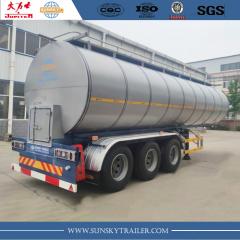
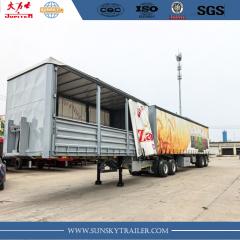
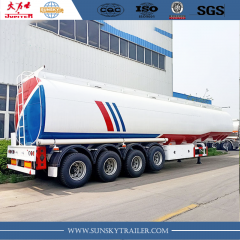
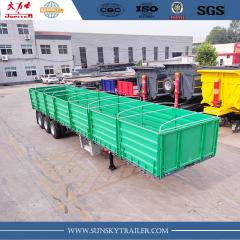
In the world of heavy-duty logistics, choosing the right trailer configuration isn't just about hauling capacity—it's about maximizing every mile. Two of the most debated setups are the Pup Trailer and the Drawbar Trailer.
While they might look similar to the untrained eye, their impact on fuel efficiency, maneuverability, and ROI varies significantly depending on your cargo and route. Let’s dive into the technical breakdown to see which one earns its keep in your fleet.
Difference between Pup Flatbed Trailer and Drawbar Trailer
1. Understanding the Core Differences
Before we talk efficiency, we need to define the "players."
-
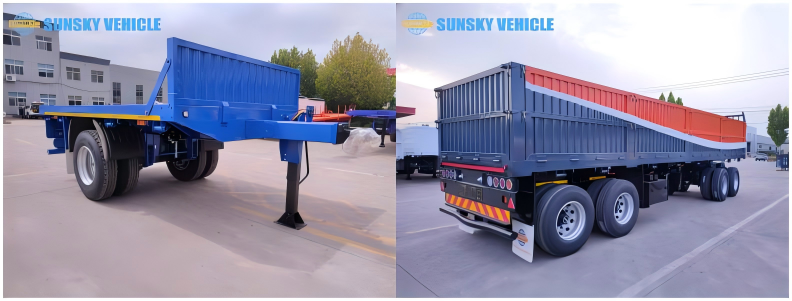
Pup Trailer: Typically a shorter trailer (20-28 feet) pulled by a semi-tractor or attached to a primary trailer (Long Combination Vehicle - LCV). It uses a kingpin and fifth-wheel connection.
-
Drawbar Trailer: A trailer characterized by a rigid or hinged "drawbar" at the front, connecting to a "rockinger" or pintle hitch on the back of a rigid truck or another trailer.
2. Maneuverability: The Efficiency of Time
Efficiency isn't just about fuel; it's about how fast you can get in and out of a loading bay.
-
The Drawbar Advantage: Drawbar trailers usually have a "turntable" front axle. This allows the trailer to follow the truck’s path more precisely during forward motion. However, reversing a drawbar trailer is a specialized skill that can be time-consuming for inexperienced drivers.
-
The Pup Flatbed Advantage: Because it uses a fifth-wheel connection, it behaves like a standard semi-trailer. It is generally easier to reverse into tight urban docks, reducing "dwelling time" and driver frustration.
3. Payload and Weight Distribution
When we talk about Weight Efficiency, we look at the $GCW$ (Gross Combination Weight).
| Feature | Pup Trailer | Drawbar Trailer |
| Stability | High (Low Center of Gravity) | Medium (Subject to "Snaking") |
| Axle Loading | Concentrated on the Fifth Wheel | Distributed across its own axles |
| Versatility | Can be part of a B-Double | Ideal for "Rigid + Trailer" setups |
Efficiency Pro-Tip: Drawbar trailers are often more efficient for high-volume, low-weight cargo (like hay or insulation) because the gap between the truck and trailer is minimized, allowing for a longer total loading platform within legal length limits.
4. Fuel Efficiency & Aerodynamics
In 2026, fuel costs are the ultimate efficiency killer.
The gap between the towing vehicle and the trailer creates aerodynamic drag.
-
Drawbar trailers often have a larger gap to allow for the drawbar's swing radius, which can create more turbulence.
-
Pup trailers in a B-double configuration sit much closer together, significantly reducing the low-pressure pocket between units and improving fuel economy by up to 5-8% compared to separate trips.
5. Operational Cost (Maintenance)
-
Drawbar: Has more moving parts in the coupling (the turntable, the drawbar eye, and the hitch). These require frequent lubrication and inspection for wear.
-
Pup Flatbed: Uses standard semi-trailer components. Maintenance is streamlined because parts are interchangeable with your larger 48ft or 53ft trailers.
The Verdict: Which is More Efficient?
Choose a Pup Trailer if:
-
You operate in a hub-and-spoke model where you need to "drop and swap" trailers quickly.
-
Your routes involve tight city turns and frequent reversing.
-
You want to utilize B-Double configurations to move more freight with one driver.
Choose a Drawbar Trailer if:
-
You use rigid trucks and want to double your capacity without buying a tractor unit.
-
You haul specialized equipment or materials (like timber or construction machinery) where a fixed-linkage provides better weight distribution over rough terrain.